

Decks & Railings Finished for How Wood Actually Wears
A deck is where your backyard actually happens, and bare, graying wood gives up more than looks — unprotected boards absorb water, cup, check, and splinter years before they should. Staining is how you keep a deck comfortable underfoot and structurally honest, and the difference between a deck that gets replaced at fifteen years and one that's still solid at thirty is mostly how consistently it was cleaned and finished.
Here's the Michigan math nobody likes: deck boards spend months under snow, then take direct overhead UV all summer, then get walked on in between. No coating on earth shrugs that off indefinitely, which is why we choose finishes by how they fail — penetrating stains that fade gradually and recoat easily, instead of film-formers that peel in sheets and demand stripping. It's also why we're straightforward that decks and other horizontal surfaces sit outside our paint warranty: nobody can honestly guarantee a walking surface under a Michigan winter, and we'd rather tell you that at the estimate than after.
Why Decks Are the Hardest Surface to Keep
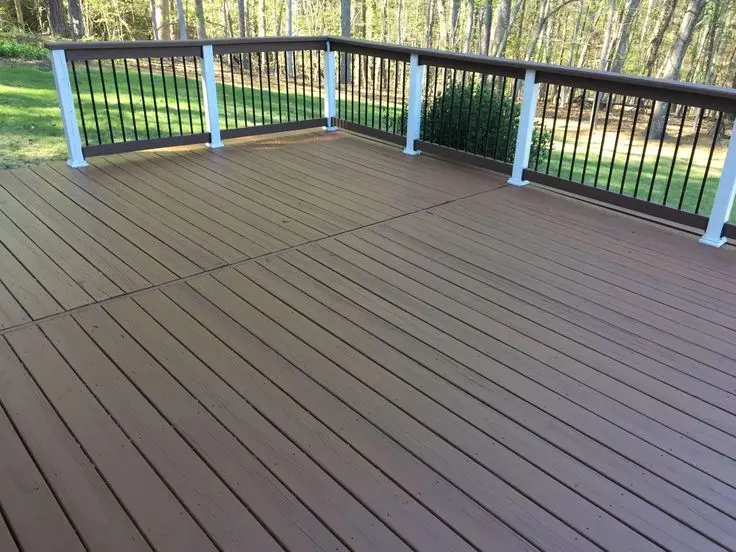
How We Do It Right
- 1Clean and brightenWe wash with a wood-appropriate cleaner and brightener that kills the gray oxidation and mildew, not just blasts at it — high pressure alone drives gray fibers deeper and furs the surface. Deck washing is a core part of our power washing service, and it sets up everything after it.
- 2Dry to the right moistureAfter washing, the wood has to dry down before it can take stain — and we verify it with a moisture meter rather than guessing off the calendar. Staining damp wood is the single most common reason DIY deck finishes fail in the first year.
- 3Repairs and refasteningSoft boards get replaced by our in-house carpentry crew, loose railings get secured, and proud nails and screws get set back down before anyone kneels on that deck with a stain pad. A finish over failing boards is money down the gaps.
- 4Sand where the wood needs itTraffic areas, splintered spots, and any furring raised by washing get sanded so the surface takes stain evenly. On a deck this is targeted work — the goal is uniform absorption, not a furniture finish.
- 5Penetrating stain on the boardsDeck boards get Ready Seal, a deep-penetrating oil stain and sealer that soaks in instead of forming a film — so it can't peel, and future maintenance coats blend in without stripping or sanding. We apply it thin: on horizontal wood, a coat the boards can absorb beats a layer sitting on top, every time.
- 6Verticals on their own systemRailings, spindles, and skirting hold finish far longer than the walking surface, so they get WoodLuxe — available from translucent to solid — and their own recoat schedule. Treating verticals and boards as one surface is how decks get over-maintained in one place and under-protected in the other.
What We Put On It
Every product below links to its full page — real technical specs from the manufacturer, not marketing copy.
What Drives the Cost
See decks we've brought back from gray in the Cost & Color Gallery — real Metro Detroit projects with the stains used and what they cost.
Browse Real Projects & CostsFrequent Questions
No — and we tell you that before you sign, not after. Our 2-year standard warranty, extendable to 4 years, excludes decks, fences, and horizontal surfaces, because no honest contractor can guarantee a walking surface that spends months under snow. It's also exactly why we use penetrating stains that fade gradually and recoat easily instead of films that fail all at once.
Plan on the walking surface needing attention every 1 to 3 years and verticals lasting 3 to 5 — sun exposure and traffic decide where in that range your deck lands. The good news with a penetrating stain is that a maintenance coat is quick and blends invisibly, with no stripping or sanding. Short, easy cycles beat long, expensive ones.
We'll talk you out of it on the walking surface. Paint is a film, and films on Michigan deck boards eventually peel — then the only path forward is stripping, which costs more than years of stain maintenance. On verticals like railings and skirting, solid-color finishes are a reasonable choice; on boards, penetrating stain is the honest answer.
Any decent stretch inside the warm season works — what matters is dry wood and moderate temperatures, not a specific month. The wood needs to dry down after washing before stain goes on, so the real requirement is a dry window, and we schedule deck work around exactly that.
Usually not immediately. New pressure-treated lumber comes saturated with treatment moisture and needs time to dry before stain can penetrate; sealing it too early traps that moisture and shortens the finish's life. We'll check your boards' readiness rather than guess — the free estimate is a good excuse to have it looked at.
Ready for a Straight Answer on Your Decks & Railings?
Free estimate, written surface-by-surface plan, and a free color consultation with every project — no pressure, ever.